AI Image Models Tested: Which AI Delivers the Best Product Photos?

Henriette Rasmussen

AI Image Models Tested
Product photography is undergoing a paradigm shift: away from the physical set, towards generative AI. But which model delivers the most professional results with the same inputs?
To find out, we used AMALYTIX to create precise prompts for seven typical e-commerce scenarios and seven products from Amazon’s catalog. These include Application Images, Infographic Images, Lifestyle Images, Macro Images, Rendering Images, Scale and Size Images, and Seasonal Gift Images.
These prompts were then tested on a range of modern AI image models. Our comparison includes: Flux.2 [Flex], Flux.2 Pro, Google’s models Gemini 2.5 Flash Image and Gemini 3 Pro, as well as GPT Image 1 and GPT Image 1.5 by OpenAI.
In this article, we compare the results and show which AI delivers the best product images.
Evaluation Criteria
For a structured and clear analysis of the AI models, we developed a detailed evaluation system. Each image is independently assessed by two experts from our marketing team based on three core criteria. A score from 1 (poor) to 5 (very good) is awarded in each category:
-
Overall Impression: This category assesses the visual impact, image composition, and overall quality of the result.
-
Realism: This evaluates the credibility and authenticity of the generated elements. Assessment criteria include natural proportions, correct object structures, and coherent lighting.
-
Prompt Accuracy: This category measures how precisely the instructions were followed. The decisive factor is the content’s consistency with the prompt.
The final overall score is then calculated as the average of all individual ratings.
The two Flux models refused to create images for the product magnesium in five out of seven test scenarios. The reason given was “Content moderated,” which suggests overly strict content filtering.
Application Images
Select a product:
Application images show a product in a typical usage scenario. They help Amazon customers to imagine its use in everyday life and to better understand the practical benefits of the item.
Both Gemini 3 Pro and GPT Image 1.5 delivered convincing results. The generated images appeared largely authentic and placed the products in credible, contextually appropriate scenes. For example, the models depicted the backpack and camera in realistic scenes, with human-product interactions appearing mostly flawless and natural.
In contrast, the Flux models had visible difficulties with this task. Unnatural body postures, anatomical errors, or incorrect depictions of the product itself occurred more frequently. Flux 2 Pro also often interpreted the core of the prompt imprecisely, leading to irrelevant or unusable results.
Particularly detailed products like the backpack pushed the models to their limits. Likewise, the realistic representation of the fire bowl in the correct size and texture proved to be a challenging requirement.
Conclusion: Creating high-quality application images remains a complex challenge for AI models. Gemini 3 Pro delivered the most consistent and convincing results here, while other models showed weaknesses in depicting human-product interactions and in prompt understanding.
Infographic Images
Select a product:
Infographics are intended to visually and concisely summarize product features. Through text, icons, and a clear structure, complex information is made easily understandable for customers.
In the creation of infographics, Gemini 3 Pro emerged as the top performer and achieved the highest score, as it implemented textual content most reliably and accurately across all product categories. GPT Image 1.5 also delivered strong results and often stood out with more visually appealing infographics. However, on closer inspection, weaknesses in text rendering were still evident. While this represents a clear improvement over its predecessor, Gemini 3 Pro proved to be more reliable in rendering text accurately.
A general problem area remained realism. Only Gemini 3 Pro, GPT Image 1.5, and Flux.2 Pro delivered reasonably convincing results here. At the other end of the spectrum was GPT Image 1, whose results were perceived as particularly artificial.
A particular discrepancy was shown by Flux.2 Pro: although the model produced comparatively realistic images, it often missed the actual task, ignoring the requirement to create an infographic.
Conclusion: For a long time, text rendering was considered the Achilles’ heel of AI image models, making infographics largely impractical for ecommerce use. GPT Image 1.5 and Gemini 3 Pro demonstrated notable progress in this area, delivering several results that are genuinely usable in practice. For Gemini 3 Pro, the infographic scenario was even the highest-rated category across the entire test. Other models, such as Flux.2 Pro, are capable of producing realistic images but fail at the core task. In most cases, manual post-processing of the infographics is still required.
Lifestyle Images
Select a product:
Lifestyle images show products in an appealing, everyday environment. They aim to build an emotional connection with the customer and convey the brand message by presenting the item in a relevant context.
Overall, this category was among the better-rated scenarios. The models showed a high accuracy in implementing the prompts and understood the desired scenarios. The biggest and most consistent weakness, however, was in realism. The depicted scenes often looked artificial and inauthentic.
The clear winner here was also Gemini 3 Pro. It was the only model to consistently deliver convincing results and achieved high scores in all three evaluation criteria. It was best at integrating the products into a credible and appealing environment. GPT Image 1.5 also performed well, scoring particularly high on prompt accuracy. In the backpack scenario, however, the model made a significant error by hallucinating an additional hand in the image.
The general weakness in realism was evident in the other models. GPT Image 1 stood out negatively here, with its images looking the most unnatural. The other models also had difficulties creating authentic and photorealistic scenes, even when the content of the prompt was correctly implemented.
Conclusion: The AI models are already good at creating the content for lifestyle images. However, the decisive challenge remains the photorealistic representation that gives the images the necessary authenticity. In this respect, Gemini 3 Pro clearly stands out from the competition.
Macro Images
Select a product:
Macro images are extreme close-ups that highlight the finest product details, material texture, and quality features. They are crucial for demonstrating an item’s value and workmanship.
This scenario was one of the worst-rated in the entire test, revealing a key weakness of AI models: the realistic depiction of details. The generated close-ups consistently looked unnatural and artificial, which was reflected in the lowest realism score of all categories.
Here too, Gemini 3 Pro was the clear winner. The model was particularly convincing due to its high prompt accuracy, most reliably implementing the technically precise instructions for macro shots.
Significant problems with realism were evident in all other models. GPT Image 1, with its extremely artificial-looking images, delivered the weakest results in this regard. Flux 2 Pro, in turn, had the greatest difficulty understanding the instructions and often failed at the basic task of creating a macro shot.
Conclusion: Creating credible macro images is one of the biggest hurdles for current AI models. The ability to produce realistic textures and up-close details is still limited overall. However, with sufficient contextual information in the prompt or clear reference images that explicitly show the product’s materiality and surface structure, convincing results can already be achieved in some cases. Gemini 3 Pro once again delivered by far the best results in this category.
Rendering Images
Select a product:
Renderings are computer-generated, photorealistic images of products. They are often used for studio shots with perfect lighting, displaying prototypes, or visualizing products in a neutral, controlled environment.
Similar to other technically demanding scenarios, creating convincing renderings was a major challenge for most AI models. While the prompts were generally understood, the results often lacked the crucial photorealism required for renderings.
The surprising frontrunner in this category was Gemini 2.5 Flash Image, which performed slightly better than Gemini 3 Pro. This was the only scenario in the test where this model took the lead. Both Gemini models, together with GPT Image 1.5, were the only models to deliver convincing, realistic results suitable for professional use.
The other models—Flux.2 Pro, Flux.2 [Flex], and GPT Image 1—could not keep up. Their results suffered from a very low realism score, making them unusable for creating high-quality renderings. The generated images looked flat and artificial, and did not meet the expectations of a photorealistic representation.
Conclusion: The ability to generate high-quality renderings separates the wheat from the chaff. Only the two Gemini models and the latest GPT model are capable of delivering the realism that is essential for this type of product image. The other tested models fail to meet this technical requirement.
Scale/Size Images
Select a product:
Scale and Size Images, i.e., size comparison images, have the task of making the dimensions of a product understandable by showing it in relation to a known object. This helps customers to realistically estimate the size and avoid wrong purchases.
This scenario proved to be the most demanding task in the entire test, achieving the worst overall ratings. The models showed fundamental difficulties in depicting correct proportions, size ratios, and a credible perspective, which was reflected in the lowest realism score of all categories.
Gemini 3 Pro and GPT-Image-1.5 take the lead here. However, even these models do not always represent scale and proportions convincingly or in a realistic manner.
The other models fail at this task. The Flux models and GPT Image 1 in particular have visible difficulties in correctly representing scale, which is expressed in incorrect and unnatural proportions. Interestingly, most models understood the instruction in the prompt but could not correctly apply the physical laws of proportion and perspective.
Conclusion: The correct representation of size ratios remains one of the biggest weaknesses of AI image models. While most models fail at a credible visual implementation, Gemini 3 Pro and GPT-Image-1.5 have proven to be slightly more reliable options for this task.
Seasonal Gift Images
Select a product:
Seasonal images position a product as an ideal gift for a specific occasion like Christmas, Easter, or Valentine’s Day. They create an emotional, thematically appropriate atmosphere to increase the incentive to buy.
This scenario was among the better-rated in the test. The models reliably followed the instructions for seasonal themes, but the results were often unconvincing in their final aesthetics and visual impact.
Here too, Gemini 3 Pro dominated with the best overall performance. The model shone with precise prompt implementation and was the only one capable of consistently generating high-quality, appealing seasonal images.
Although GPT-Image-1.5 precisely followed the specific requirements for seasonal gift images, the resulting product images often lacked realism.
In the mid-range, Flux.2 Pro showed a balanced performance, delivering images with a good overall impression and realism, even if the prompts were not always followed precisely. The biggest deficit was with GPT Image 1, whose images were the least aesthetically appealing. Even when the instructions were followed correctly, the overall visual impression was the weakest here.
Conclusion: Most models are good at creating thematically appropriate seasonal images. The real challenge lies in creating an aesthetically high-quality and emotionally appealing composition. For this creative task, Gemini 3 Pro is by far the most reliable choice.
Evaluation
After seven intensive test rounds across all relevant e-commerce scenarios, a clear winner has been determined: Gemini 3 Pro. The Google model convinced us with the highest overall rating, proving to be by far the most versatile and reliable tool for creating product images.
The Overall Result
As the evaluation of the total scores shows, Gemini 3 Pro comes out on top with an average score of 3.5. GPT-Image-1.5 takes second place with a score of 3.2, ahead of Gemini 2.5 Flash Image at 2.7. The Flux models (2.5 and 2.3) and GPT Image 1 (2.0) trail behind.
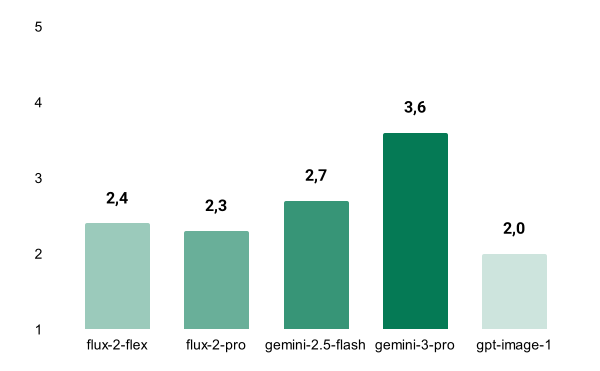
The strength of Gemini 3 Pro lies, above all, in its consistency. The model led the field in six out of seven scenarios. While the “Seasonal Gift” scenario was the best-rated across all models with an average score of 2.9, complex “Macro” shots (average 2.4) represented the greatest challenge for all AI models.
The overall impression – a combination of image composition and visual impact – confirms this picture:
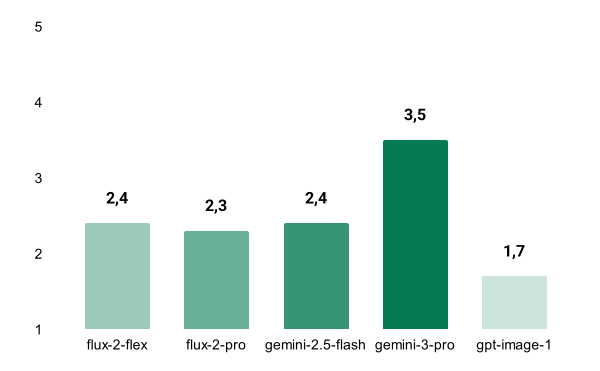
What is striking here, however, is that the overall winner does not necessarily lead in every niche. In the “Rendering” area, the Gemini 2.5 Flash model achieved the best individual result with a score of 3.26. For the specific combination of rendering the magnesium product, it even achieved the absolute highest score of 5.0. For users focusing purely on rendering tasks, this model can be a more efficient solution.
For practical examples of AI-supported image creation and prompts for various image types, we recommend taking a look at our whitepapers on “AI Image Creation” and “Amazon Prompts”.
The Technical Discrepancy: Understanding vs. Photorealism
A detailed analysis of the “Prompt Accuracy” and “Realism” criteria reveals a systematic pattern across all tested models: the AIs interpret instructions correctly in terms of content but often fail at the photorealistic implementation.
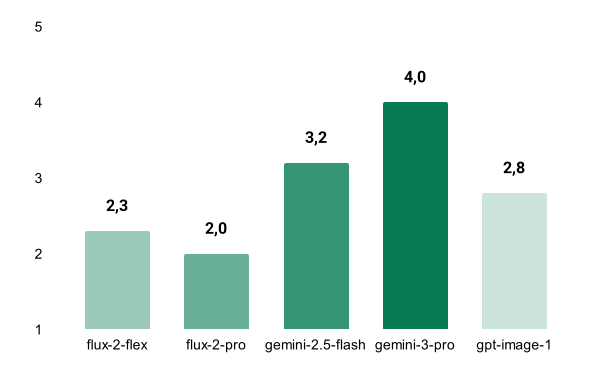
Prompt accuracy scores are high, with Gemini 3 Pro achieving a 4.1. This means that when specific elements are requested in the prompt, the models usually place them correctly.
Realism, on the other hand, is the technical bottleneck. Even for the leading model, the rating in this category drops to 3.0, and for GPT Image 1, it plummets to 1.5.

This discrepancy is the main reason for point deductions. The difficulty lies in creating an image with natural proportions, correct object structures, and coherent lighting. Across all models, prompt accuracy scores are consistently higher than those for realism.
This observation is supported by statistical analysis: a strong correlation between realism and overall impression confirms that photorealistic rendering is the decisive factor for image quality, while prompt accuracy correlates much more weakly with the other criteria.
Model-Specific Observations
Beyond the quantitative ratings, certain model-specific characteristics emerged during testing:
-
Flux (Pro & Flex): The results were ambivalent. Although the models often produced aesthetically pleasing images, they lacked consistency. The Flux.2 Pro model recorded the test’s lowest individual score (1.0) in the Lifestyle / Garlicpress scenario and showed a notable weakness in the “Scale/Size” scenario. Another technical detail: Flux often generated images in the format of the input image instead of the size defined in the prompt, though this can be manually adjusted in the task settings.
-
GPT Image 1: This model is notable for a consistent soft-focus effect. Although the prompts are implemented solidly, the artificial “soft look” appears unrealistic and severely limits its usability for e-commerce. With an overall score of 2.0, it performed the worst in the test.
-
GPT Image 1.5: As with its predecessor, this model typically applies a very strong bokeh effect, leaving the background with hardly any recognizable details. In an ecommerce context, this stylistic choice is often used deliberately to keep the product clearly in focus. Notably, the GPT models apply this effect much more aggressively than Gemini or Flux.
Create high-quality product images in under a minute. Our AMALYTIX AI feature combines your product data with intelligent image ideas. Generate professional lifestyle and application scenes – without any design effort or external tools.
Conclusion
For professional applications, Gemini 3 Pro is currently the most reliable choice. However, alternatives are available for specific use cases: Gemini 2.5 Flash is a strong choice for pure rendering tasks, while GPT-Image-1.5 delivers comparable results for application images. The test also highlights general limitations: the automated creation of infographics and the integration of text still show significant potential for optimization, and photorealism still requires manual oversight.
Input is crucial for image quality: detailed context, such as reference images or precise bullet points, is key to achieving precise results. For example, when we only provided a product’s main image, the models often struggled to correctly represent details from other perspectives.
Overall, the results show that AI models offer high practical value in e-commerce but are not yet fully automatic solutions. The technology functions most effectively as an assistance system that accelerates the creation of image variants, while final curation and fine-tuning remain in human hands. Those who use the models’ strengths and compensate for their known weaknesses—especially in realism—through post-processing can realize significant efficiency gains today.
Simply register for a 14-day free trial for AMALYTIX and we will show you how our tool can help you monitor your products daily. Start your free trial now.
FAQ
Which AI is best for product images?
According to our test, Google’s Gemini 3 Pro is currently the best model for creating product images. It delivered the most convincing and reliable results in almost all e-commerce scenarios, especially in technically demanding categories.
What are the biggest challenges for AI image models?
The current models show the greatest weaknesses in creating infographics with readable text, photorealistically representing details (e.g., in macro shots), and correctly depicting size ratios. Consistently representing products from different perspectives also remains a hurdle.
Why is Gemini 3 Pro the test winner?
Gemini 3 Pro distinguished itself through its high versatility and reliability. The model was convincing in creative tasks like lifestyle images and technically complex requirements like size comparisons and detail shots. Its combination of realism, aesthetics, and precise prompt understanding was superior to the competition.
What is important for good AI product images?
The quality of the input is the decisive factor. Detailed prompts with precise instructions (e.g., bullet points) and reference images are key to high-quality results. The more context the AI has, the better it can generate the desired images.
Subscribe to Newsletter
Get the latest Amazon tips and updates delivered to your inbox.
We respect your privacy. Unsubscribe anytime.