Amazon Brand Analytics (ABA): reports, access and metrics

Amazon Brand Analytics (ABA) shows what shoppers search for on Amazon and how they behave before they buy. You also see how often they come back to your brand and which products they order together. Amazon’s own analytics tool for registered brands costs nothing extra. Sellers find it in Seller Central; vendors get part of the reports.
This article covers which reports exist today and which of them are available on amazon.de. Worked examples show how to use repeat purchase and market basket data for bids and bundles.
The vendor reports Sales, Inventory, Traffic, Forecasting and Net PPM are not part of Brand Analytics. They live in Amazon Retail Analytics (ARA).
Who can use Amazon Brand Analytics?
Sellers need a Professional selling account and the Brand Representative role for a brand in Amazon Brand Registry. The person with this role must work for the brand. You apply for Brand Registry at sell.amazon.com/brand-registry. According to Amazon’s Brand Analytics help page, the brand administrator can also invite other seller accounts and give them access under “Manage selling benefits”.
In a shared account, a team member also needs the “Amazon Brand Analytics” permission in User Permissions. The primary account administrator grants it.
Vendors with a registered brand get only part of the reports. In Vendor Central (Reports › Brand Analytics), they see Top search terms, Repeat purchase behaviour and Market basket analysis. Search Query Performance and Search Catalog Performance are not there, and in the API they are available to sellers only.
Where to find Brand Analytics in Seller Central
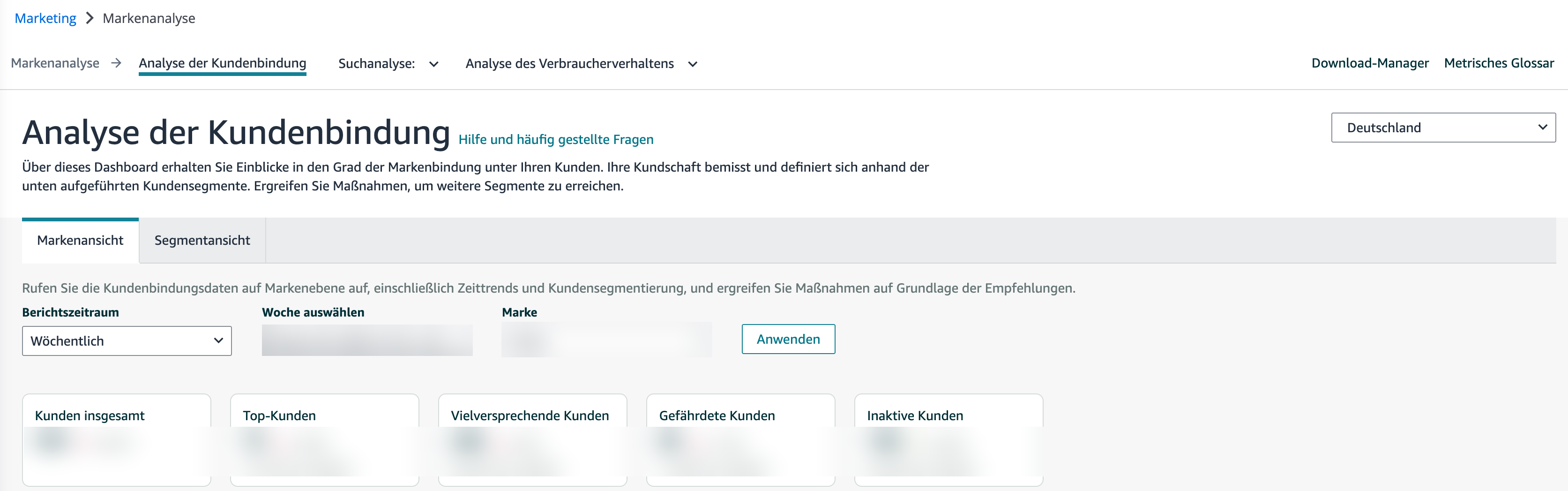
In Seller Central, Brand Analytics is under Marketing › Brand Analytics, in the classic menu under Brands › Brand Analytics. In the German interface it is called “Markenanalyse”. Vendors with a registered brand open Reports › Brand Analytics in Vendor Central.
Which reports are in Amazon Brand Analytics?
Amazon sorts the dashboards into four groups: Search Analytics, Consumer Behavior Analytics, Customer Loyalty Analytics and Customer Journey Analytics. Not every dashboard exists on every marketplace: the German menu has no Customer Journey Analytics and no Demographics.
| Group | Report | amazon.de | Seller / vendor (API) |
|---|---|---|---|
| Search Analytics | Top Search Terms | yes | seller and vendor |
| Search Analytics | Search Query Performance | yes | seller only |
| Search Analytics | Search Catalog Performance | yes | seller only |
| Consumer Behavior | Repeat Purchase Behavior | yes | seller and vendor |
| Consumer Behavior | Market Basket Analysis | yes | seller and vendor |
| Consumer Behavior | Demographics | no, US only | no API |
| Customer Loyalty | Customer Loyalty Analytics | yes | no API |
| Customer Journey | Customer journey, High-impact products | no | no API |
Search analytics: what shoppers search and find
The three dashboards show the market and your products’ path from impression to purchase. Top Search Terms shows what all shoppers search for. Search Query Performance and Search Catalog Performance show how your products do in those searches.
Top Search Terms
Top Search Terms lists the search terms on Amazon with their Search Frequency Rank and category. For each term you see the three most-clicked ASINs with their click share and conversion share. Amazon also names the top brands and categories per term. You choose day, week, month or quarter.
If you have used Brand Analytics for a while: the dashboard used to be called “Amazon Search Terms”, and in the API it is still the “Amazon Search Terms Report”. How to read the report and use it for listings is covered in our article on the Search Terms report in Brand Analytics.
Search Query Performance
Search Query Performance shows the search volume and a search query score for each search query. Then come the steps to the purchase: impressions, clicks, add-to-carts and purchases, each as a total, as the value for your products and as your share. You switch between Brand View and ASIN View. Amazon counts organic results and Sponsored Products on the search results page.
The dashboard is available for Germany. In the API it is available to sellers only. All metrics and typical analyses are explained in the article Search Query Performance report in detail.
Search Catalog Performance
Search Catalog Performance turns the view around: you start from the ASIN instead of the search term. Across all search queries you see impressions, clicks, click rate, add-to-carts, purchases, sales from search traffic, conversion rate and median prices. Impressions, clicks, add-to-carts and purchases are also split by shipping speed (same day, one day, two days). A week here runs from Sunday to Saturday. The dashboard is available for Germany.
Many impressions, few add-to-carts: if Search Catalog Performance shows this pattern for an ASIN, switch to Search Query Performance. There, look for the search queries where shoppers click the product less often or add it to the cart less often.
Analysing search terms weekly in AMALYTIX
Another week, another list: you download Top Search Terms and put last week’s list next to it. Which search terms are new, which are rising fast? You have to work that out in spreadsheets.
In the Brand Analytics module of AMALYTIX, the Search Term Report pulls the data through the SP-API (Selling Partner API). The weekly view shows the top search terms, new search terms and the risers compared with the previous week. You still decide which terms belong in your listings and campaigns.
The biggest gains compared with the week before.
- ice scraper1,2049,880+8,676
- thermal underwear women2,3107,950+5,640
- mulled wine mug3,1208,400+5,280
- electric blanket6404,910+4,270
- kids hot water bottle4,4808,115+3,635
- door draft stopper5,9309,210+3,280
Search frequency rank: the lower, the more often it is searched.
See every week which search terms are new and which are rising, without comparing the lists yourself. Start your 14-day free trial
Repeat purchases: Repeat Purchase Behavior
The first sale is done. Repeat Purchase Behavior shows how many of your customers buy again. Amazon counts every order after the first one that the same customer places for the same brand or ASIN in the selected period as a repeat purchase. Amazon does not subtract returns and cancellations. The data goes back three years.
You choose Brand View or ASIN View. In ASIN View you can search for up to 100 ASINs at once. The available periods are weekly, monthly, quarterly and yearly.
How to read the metrics (Amazon’s names from the help page and API):
- Orders: number of orders in the period.
- Repeat ordered product sales: sales from repeat purchases, the change from the previous period and the share of total sales.
- Repeat ordered units: units sold through repeat purchases, the change and their share of all units.
- Repeat customers: customers with more than one order, with the change from the previous period.
- Repeat customers % of total: repeat customers as a share of all customers.
A made-up example: 100 customers buy an ASIN in a quarter. 12 of them order again in the same quarter. That is a repeat customer share of 12 %.
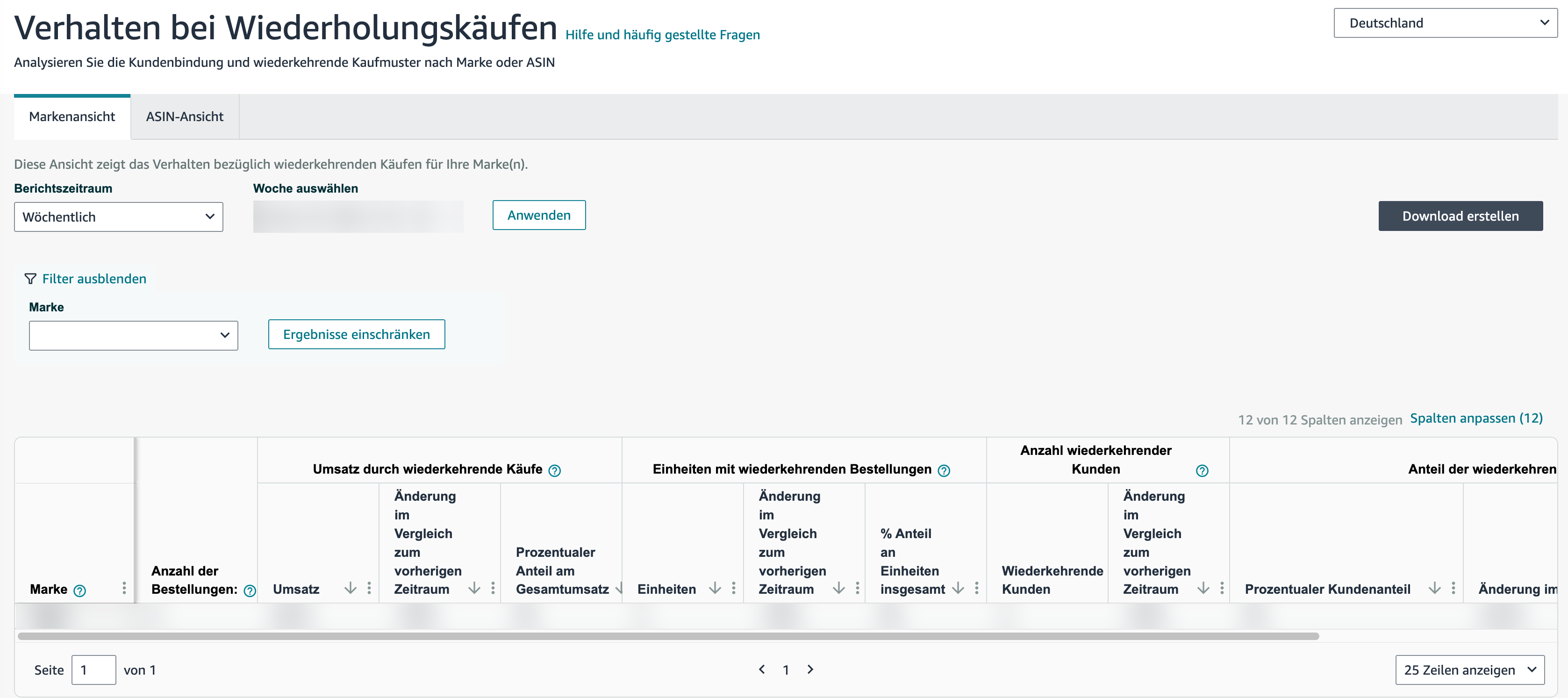
Sort the ASINs by repeat ordered product sales. In our view, many repeat customers justify a higher bid in Sponsored Products for the first order: the first sale brings follow-up orders that you do not have to pay to advertise again. If hardly anyone buys again, the first sale has to pay off on its own.
Market Basket Analysis
What do shoppers order with your product? Market Basket Analysis shows, for each of your ASINs, the three products most often found in the same order, and how often that happens. These can include products from other brands.
The Combination % shows how often the products are ordered together. Amazon divides the orders that contain both products by all orders that contain your product and at least one other, different item. A made-up example: 1,000 orders contain your product and at least one other item. 150 of them also contain product X. That is a Combination % of 15 %.
The display filter offers all products, same-brand combinations only, or same-brand combinations excluded. With the ASIN search you look up to 100 ASINs at once. The interface offers weekly, monthly and quarterly periods. In the API, the data is also available by day.
Sellers and vendors with the Brand Analytics role and a registered brand get this report. Vendors open Market Basket Analysis under Reports › Brand Analytics in Vendor Central.
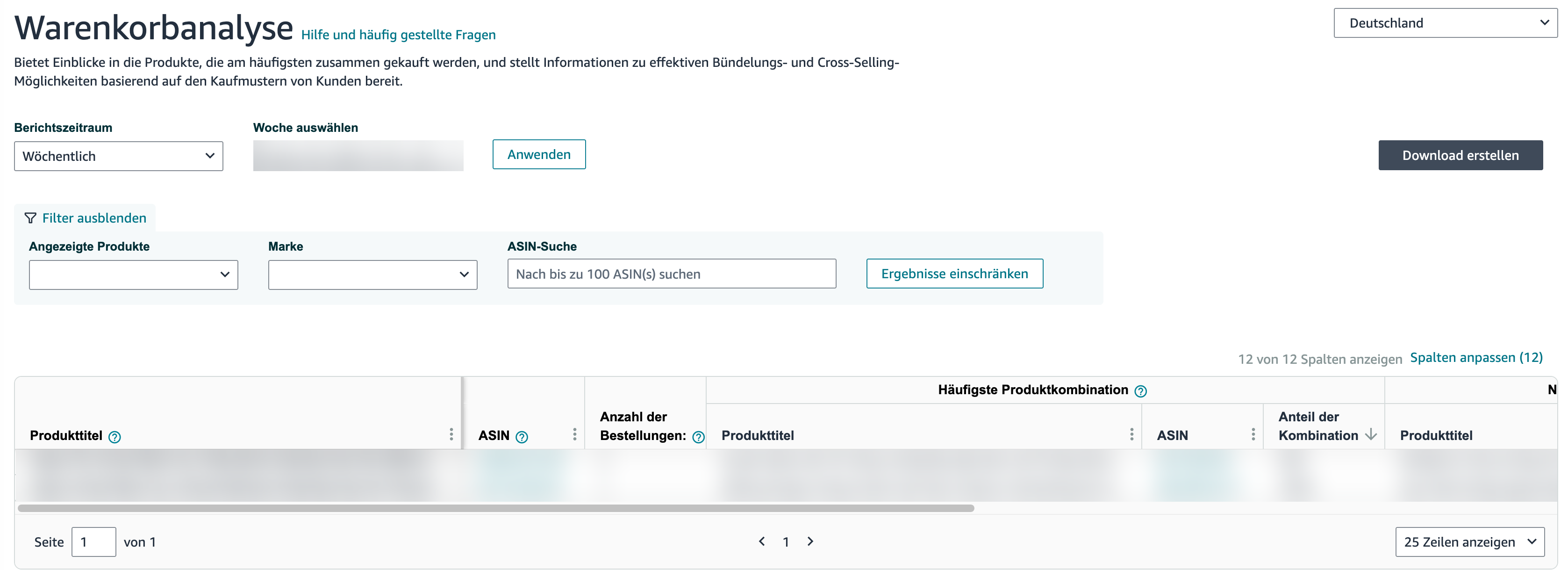
Frequent combinations give you ideas for sets and advertising:
- Bundles: if two of your products are often bought together, offer them as a set or virtual bundle.
- Product targeting: target Sponsored Products at the co-purchased ASINs. Shoppers who buy these products often add yours to the cart too.
- Note on the product page: the “Frequently bought together” sections on product pages are not advertising.
In our experience, a Combination % below about 10 % can be chance. That is our rule of thumb, not a figure from Amazon.
Demographics, customer loyalty and customer journey
These three areas have no API. On amazon.de, only Customer Loyalty Analytics is available.
Demographics shows your customers’ age, household income, education, gender and marital status. For each group you see unique customers, sales and units with their share of the total. Amazon says: “This dashboard is only available in the United States.”
Customer Loyalty Analytics splits your customers into segments: Top Tier, Promising, At Risk and Hibernating. You switch between Brand View and Segment View and see trends and Amazon’s recommendations. In German Seller Central, Brand Analytics opens with this dashboard (“Analyse der Kundenbindung”). Amazon’s help page describes the US version and also names a predicted customer lifetime value.
Customer Journey Analytics shows the stages shoppers go through before they buy, and the products with the most influence on them. The German Seller Central menu does not have it (October 2026).
Demographics: according to Amazon, US only.
Customer Journey Analytics: not in the German menu.
What is no longer in Brand Analytics
Is a report from an older guide missing? Amazon retired some; others now belong to a different area.
Item Comparison and Alternate Purchase Behavior: this report was retired on 30 June 2022.
Customer Reviews: Brand Analytics no longer has a customer reviews dashboard. In Seller Central, customer reviews now have their own page in the Products menu. How to keep an eye on your product reviews anyway is covered in our article on Amazon reviews.
Vendor reports: Snapshot, Sales Diagnostic, Inventory Health, Geographic Sales Insights, Pre-orders and Real-Time Sales were reports for vendors. Today they are not part of Brand Analytics. Our ARA article explains what happened to the Sales Diagnostic and Inventory Health reports. The real-time data is now called Rapid Retail Analytics and also lives in ARA.
Exporting data and using the API
Each dashboard has a download button that requests a file. Finished files are in the Download Manager. The interface offers no scheduling or e-mail delivery.
The data usually goes back three years. New data usually takes three days to arrive, data for the end of a quarter about a week.
Periods per report:
- Top Search Terms: day, week, month, quarter
- Search Query Performance: week, month, quarter
- Search Catalog Performance: week, month, quarter
- Repeat Purchase Behavior: week, month, quarter, year
- Market Basket Analysis: week, month, quarter; day only in the API
You can also pull five reports through the SP-API. For this you need the “Brand Analytics” API role and a registered brand. You can only request the reports one at a time, not schedule them, and they come as JSON:
GET_BRAND_ANALYTICS_SEARCH_TERMS_REPORT(Top Search Terms)GET_BRAND_ANALYTICS_SEARCH_QUERY_PERFORMANCE_REPORT(Search Query Performance)GET_BRAND_ANALYTICS_SEARCH_CATALOG_PERFORMANCE_REPORT(Search Catalog Performance)GET_BRAND_ANALYTICS_REPEAT_PURCHASE_REPORT(Repeat Purchase Behavior)GET_BRAND_ANALYTICS_MARKET_BASKET_REPORT(Market Basket Analysis)
There is no API for Demographics, Customer Loyalty Analytics and Customer Journey Analytics.
Conclusion
For keywords, start with Top Search Terms and Search Query Performance. What do shoppers search for, and where do your products lose clicks or add-to-carts? For your bids, check Repeat Purchase Behavior: many repeat customers justify a more expensive first sale. Market Basket Analysis gives you ideas for bundles and for product targeting in Sponsored Products. Vendors find sales and inventory in Amazon Retail Analytics.
Frequently asked questions about Amazon Brand Analytics
Is Amazon Brand Analytics free?
Yes. There is no separate fee for Brand Analytics. You do need a brand in Brand Registry, and as a seller also a Professional selling account.
Who has access to Brand Analytics?
Sellers with the Brand Representative role for a registered brand. The person must work for the brand. The brand administrator can invite other seller accounts. Team members in a shared account also need the “Amazon Brand Analytics” user permission.
Do vendors get Brand Analytics?
Yes, but only part of it. In Vendor Central, vendors see Top search terms, Repeat purchase behaviour and Market basket analysis, but not Search Query Performance. Vendors find the Sales and Inventory reports in Amazon Retail Analytics.
Are demographics available outside the US?
No. According to Amazon, the Demographics dashboard is only available in the United States.
What happened to the Item Comparison report?
Amazon retired the Item Comparison and Alternate Purchase Behavior report on 30 June 2022.
Can I get Brand Analytics data via API?
Yes, five reports: Top Search Terms, Search Query Performance, Search Catalog Performance, Repeat Purchase Behavior and Market Basket Analysis. You need the “Brand Analytics” SP-API role. The reports come as JSON.
Which geographic sales data can Amazon Brand Analytics report on?
None. Brand Analytics has no geographic sales report today. Geographic Sales Insights was a report for vendors and was retired with the 2022 relaunch of Amazon Retail Analytics.
Subscribe to Newsletter
Get the latest Amazon tips and updates delivered to your inbox.
By subscribing you agree to our Privacy Policy .